Showing posts with label science. Show all posts

Wednesday, October 7, 2009

2009 Nobel Prize

This year's Nobel winners come so close to me.

I had a brief collaboration with Thomas Steitz but the project didn't go anywhere; I had seriously considered applying for a post-doc opening at Elizabeth Blackburn's lab for telemere research back in 2000; and of course, Charles Gao was the vice-chancellor of my university when I was an undergraduate. Weird.

Friday, January 23, 2009

Obama reverses Bush's stem cell restriction

BBC news

US regulators have cleared the way for the world's first study on human embryonic stem cell therapy.

The move comes three days after the inauguration of President Barack Obama who has been a strong supporter of embryonic stem cell research.

Since 2001 there have been limits on federal funding for stem cells.

Geron Corp, the biotech company behind the research, plans to initiate a clinical trial in patients paralysed due to spinal cord injury.

The BBC predicted last week that the White House would reverse the restrictions placed on stem cell research once President Obama took office.

The US Food and Drug Administration gave the go ahead for the research on Friday.


Monday, September 29, 2008

ATV burn-up on re-entry

From BBC news:


Europe's "Jules Verne" space freighter has destroyed itself in a controlled burn-up over the southern Pacific.

The 13.5-tonne cargo ship had completed a six-month mission to the space station and was packed with the orbiting platform's rubbish.

Two engine firings were required to slow the freighter sufficiently to pull it into the atmosphere.

The European and US space agencies had chase planes in the air to try to capture the fireball on video.

Sunday, September 14, 2008

Taxi drivers 'have brain sat-nav'

from BBC news:

Scientists have uncovered evidence for an inbuilt "sat-nav" system in the brains of London taxi drivers.

They used magnetic scanners to explore the brain activity of taxi drivers as they navigated their way through a virtual simulation of London's streets.

Different brain regions were activated as they considered route options, spotted familiar landmarks or thought about their customers.

Tuesday, August 12, 2008

Memes

from July/Aug 2008 issue of Skeptical Inquirer

... Although Kim, Ji, and Hwang were Korean educated, because they earned their PhDs at prestigious universities in the United States, their scientific indiscretions cannot be attributed to academic inbreeding. What, therefore, can be the cause of this spate of unethical scientific behavior?

Richard Dawkins, in his article "Viruses of the Mind" (Free Inquiry, Summer 1993), explains the incredible vulnerability of young minds to "infection" by cultural information packets, termed "memes." Bu definition, memes are paradigms uncritically accepted as "truth," which are then amalgamated into a person's developing personality. Once installed, they act like a computer virus, contaminating the "infected" individual's clarity of reason throughout adulthood. If the meme concept is accepted, it may partly explain why some highly educated scientists' faith in their own hypotheses could be so unshakable that they would guiltlessly cook the data to make it match their conclusions. Korea's Ministry of Science might better meet its goal of elevating research ethics by investigating Korea's early childhood education than by disturbing booklets to lab directors.

Frank Reiser
Department of Biology at Nassau Community College, Garden City, New York

Although his claim of having cloned human stem cells using nuclei from epithelial cells is fabricated, Hwang's dog Snuppy is a real clone. Picture taken by amos_w.

Monday, July 14, 2008

Ice can burn

I was watching National Geography's Earth: The Biography - Atmosphere on TV.

At one point the host goes to a lake frozen for hundreds of years in Siberian. Being a permafrost, the ice in the lake traps millions of air bubbles, most of which contain methane. If permafrost melts as global temperature rises, the world will get even warmer because methane is a green house gas 34 times stronger than CO2.

Here the host demonstrates how much methane permafrost contains: he digs a small hole into the ice and lights a match above the hole. Wow.. a blaze comes out of the ice! Then he digs the hole again and a flame blows right at him!!

Saturday, July 12, 2008

Bird Songs: 250 North American Birds in Song


A colleague of mine has bought this Bird Songs: 250 North American Birds in Song and put it in the lunch room for us to play with. The book has brief descriptions of commonly seen birds in North America, and comes with sound tracks of the their songs! The drawings and the sound tracks are from the Macaulay Library at the Cornell Lab of Ornithology. I have been spending a lot of my lunch time playing the songs these days.

I hear this bird song at home all the time. It turns out to be the song of Pileated Woodpeckers.


Friday, July 11, 2008

The puzzle of Mirror Images

I ran into the puzzle of why images in the mirror are reversed left-right but not up-down. Then I found this blog, which seems to have been discontinued since 2003.

The host appears to be a grade school science teacher and was gathering puzzles and researching for the answers for his students.

So about mirror images, mirrors do not actually reverse image sideways. It is our perception of left and right that leads us ask the wrong question. He describes a simple solution:

Stand in front of a mirror facing north yourself. Raise your right arm to point east, your mirror image is also pointing east. Raise your left arm to point west, and your mirror image is pointing west. The same thing happens when you point up or down. But if you point your finger to the north (into the mirror), your image will points out of the mirror and to the south!

So the fact is, mirrors only reverse the direction of the object by the axis perpendicular to the mirror surface, just as the physical law depicts what happens to light when it hits a mirror - light traveling into a mirror travels backward (got reflected).

The host also suggests a few websites and books to read. This The Annotated Alice: The Definitive Edition seems very interesting. The books includes the original stories of Alice in Wonderland and Through the Looking Glass by Lowell Carroll and original illustrations, and very detail annotations by Martin Gardner on the historical context of the jokes and logical, topological and mathematical paradox.


Apples and Pears under Synchrotron

A group of scientists in Belgium is crazy enough to put apples and pears under synchrotron, trying to see inside the fruits and understand why pears rot faster than apples.

They found that pears have a micro-channel structure between cells, whereas apples have irregular cavities. After the fruits are picked, the cells rely on respiration to keep themselves healthy, and that needs oxygen. With highly structured and watery micro-channels, pears have less oxygen supply into the core and thus rot faster.

So the verdict is, a higher oxygen pressure in pear storage can keep pears fresh. But most of the pears in supermarkets in this country are as hard as rocks. They always need to be "matured" for as long as a week at home before a knife can cut them.

Friday, February 15, 2008

$150,000 for a dog

A California woman pays US$150,000 to clone her dead Pitbull Terrier.

American Pit Bull Terrier photo
Link

Monday, January 28, 2008

The Inner Life of the Cell

It is a bit long, but it is by far the most amazing animation for cell biology. It includes protein synthesis, trans-membrane signal transduction, intra-cellular cargo transport and leukocyte migration into tissue. Created by Robert Lue of Department of Molecular and Cellular Biology, Harvard University.


Wednesday, August 29, 2007

Stellarium

A terrific free software to view the sky and constellation as seen in numerous location of Earth, even from the moon right from your computer.


http://www.stellarium.org/

Tuesday, June 26, 2007

Earth rise as seen on the Moon

NASA Photo ID: AS08-14-2383
File Name: 10074963.jpg
Film Type: 70mm cn
Date Taken: 12/22/68

Title: View of rising Earth about five degrees above the Lunar horizon

Description:

The rising Earth is about five degrees above the lunar horizon in this telephoto view taken from the Apollo 8 spacecraft near 110 degrees east longitude. The horizon, about 570 kilometers (250 statute miles) from the spacecraft, is near the eastern limb of the Moon as viewed from the Earth. On the earth, the sunset terminator crosses Africa. The South Pole is in the white area near the left end of the terminator. North and South America are under the clouds. The lunar surface probably has less pronounced color than indicated by this print.

Thursday, November 30, 2006

Planaria

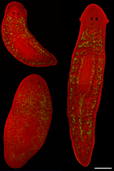
I heard a talk today. The speaker was a junior professor at the Whitehead Institute at MIT. He works with Schmidtea mediterranea, a flatworm commonly known as Planaria.

These Planaria look very funny. They are 3-8 mm long, and look like penises with eyes. Well, those dotted eyes are real photoreceptors. There are quite some levels of differentiation of tissues with them. They have brains, literally.

The most funny thing about Planaria is that they can regenerate themselves if they are cut into two halves, or eight. If you decapitate them, they regrow their head in days. If you cut them longitudinally, each of the two halves regrow into two individuals. If you play around with the chopping-up thing, you can cut the worm from its head half way into its body, the cut half of the worm will regrow into 2 full heads and you will end up with a Y-shaped worm with 2 head and one tail.

Planaria can actually reproduce asexually simply by splitting themselves into two, and the regrow into two adults. This amazing regeneration ability had attracted scientists such as Thomas. H. Morgan, who also pioneered the genetics of fruit flies, as early as in 1898.

These worms seem never die - they keep splitting themselves. In fact, they are very busy rebuilding themselves all the time. The turn-over rate of the cells within these worms are very high. The worm you see today will make up of a completely different set of cells a few weeks later.

The cool thing the speaker's lab is doing is, they now manage to use RNAi to knock down the genes in these worms. They have the genome of this S. meditteranea sequenced and designed RNAi to screen for genes that show phenotypic effects on regeneration. Basically they fed the flatworms with E. coli expressing clones of RNAi and chopped them up after 2 days. The worms that showed impaired ability to regenerate would have the gene important for regeneration knocked down.

So they have opened the treasure chest that holds the whole new world of stem cell and cancer research. The way the neoplast grow, differentiate and migrate parallels that of stem cells. The whole worm can be labeled by antibodies and BrdU, and the cells can be easily dislodged for FACs. Another goody: the differentiation is slow - it takes days to show phenotype. With such a simple system, they will be able to pick up signals that trigger regeneration/differentiation in different tissues quite easily. Also, with rapidly dividing neoplast, these worms rarely develop cancer. They must have some unique and tight control for cell division, as well as DNA repair and replication checkpoints to make sure that they do everything correctly during cell division and pass on their own genome very accurately.

The speak was Peter Reddien. He did his post-doc in Alejandro Sanchez's lab in University of Utah. Being an HHMI investigator and invited to write review articles in the Annual Review of Cell and Developmental Biology and Nature Reviews Genetics, Sanchez must be a respected figure in this field. He looks he is in his 40's only.